
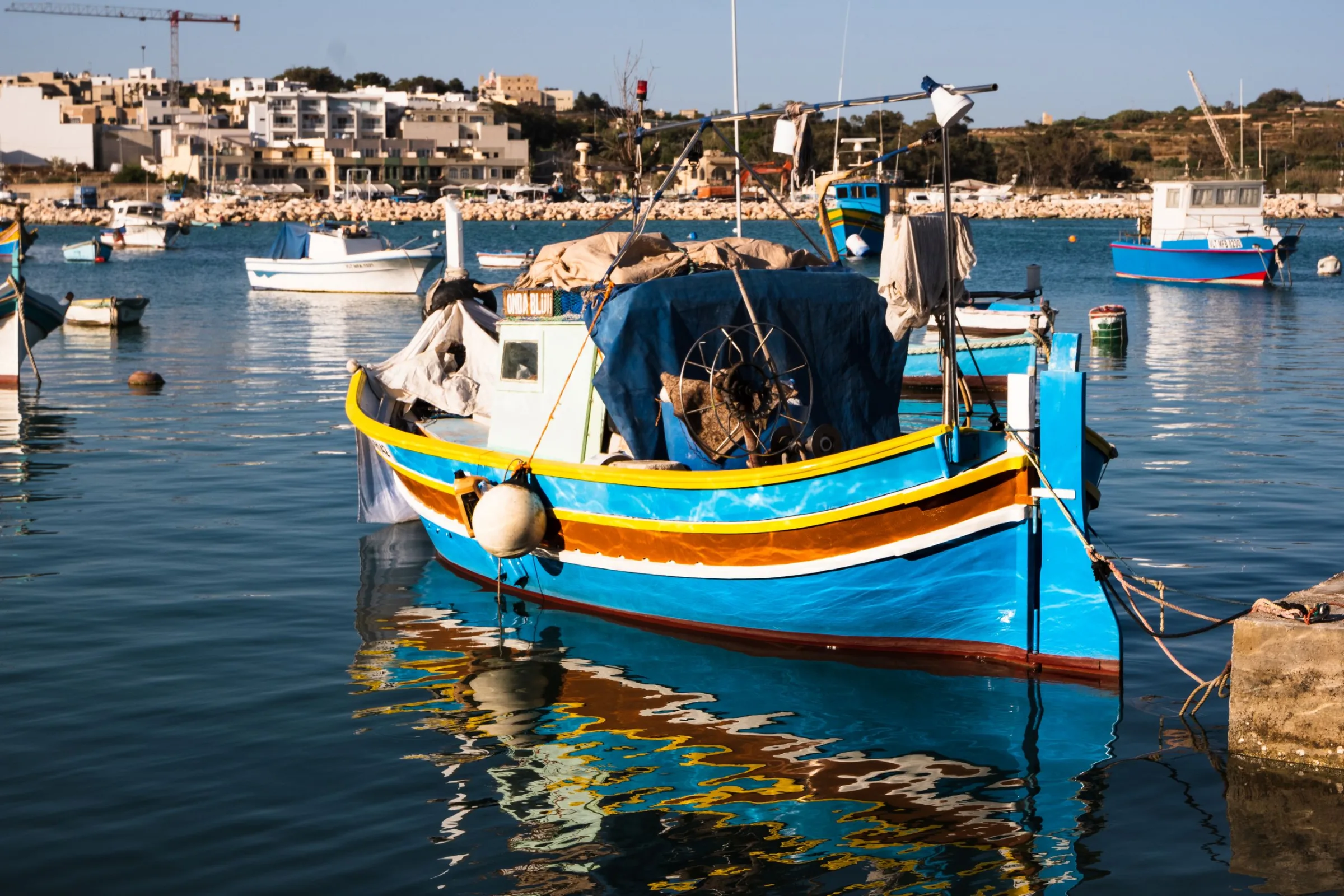
Walk a working harbour in Portugal, Greece, Kerala, Newfoundland or Brittany and you will see the same narrow range of colours on the hulls: a particular chalky blue, a rust red, a white that has gone slightly grey, and yellow trim.
This is not a coincidence, and it is not a shared aesthetic instinct. It is four separate practical constraints producing the same answer independently.
For most of the period when these traditions formed, blue pigment was expensive. Ultramarine came from lapis lazuli and cost more than gold by weight. Indigo was a trade good with a price to match.
What was cheap was copper. Copper compounds — verdigris, copper carbonate, later copper sulphate — produce blues and blue-greens, and copper was already in every harbour because it was used on hulls for a different reason entirely.
Then, from 1706, Prussian blue: the first modern synthetic pigment, produced by accident in a Berlin laboratory, cheap and stable. It reached working boats within a generation and it is very close to the blue you photograph today.
This is the load-bearing reason.
Marine organisms — barnacles, weed, shipworm — foul a hull, slow it and eventually destroy it. Copper is toxic to them. Sheathing hulls in copper plate was standard for navies from the eighteenth century; for small boats, copper-bearing paint was the affordable version.
So a fisherman painting a hull with the compound that kept it clean was, as a side effect, painting it blue-green. The colour was a by-product of antifouling, and it became traditional because the tradition was functional.
The colour of a working boat is not a choice about how it should look. It is the visible residue of a decision about how long it should last.

The other universal colour is the rust red on hulls, sheds and net stores from Scandinavia to Nova Scotia.
Iron oxide is the most abundant pigment on earth. In Sweden it is the by-product of the Falun copper mine, giving falu rödfärg, which has coated Swedish timber buildings since the sixteenth century and which is still made from the same source. It is cheap, it is UV-stable, and it happens to be mildly protective for wood because the pigment particles block light.
Above the water the constraint inverts. There the requirement is visibility against grey sea, grey sky and green land — in poor light, at distance, by someone looking for you.
Hence the white, the yellow trim, and the strong colour blocking on gunwales and wheelhouses. In several fishing communities, individual boats were painted in family-specific combinations so they could be identified from the shore before anyone could read a name — in the Netherlands, in parts of Brittany, and in the Portuguese moliceiro tradition of the Ria de Aveiro.
This is a safety system implemented in paint, and it predates radio by centuries.
Check the practical details in this article against an official source before you travel. Prices, permits and opening times were verified in the month shown at the top of the page and they move faster than we can re-publish.
Modern antifouling paints are still frequently copper-based but come in any colour, and fibreglass hulls do not need the wood protection that iron oxide provided. The constraints that produced the palette have largely gone.
What remains is habit, regulation and tourism — in several protected harbours the colours are now specified by heritage rules, which is a strange afterlife for a chemistry problem.
If you want to photograph the real thing rather than the maintained version, look for:
And ask. Harbours are among the most conversational places on earth at that hour, and the answer to "why that blue" is frequently a specific and unexpected local one.

Editor & co-founder
Elin started Beyond The Geo in 2019 with a notebook of border-crossing times and guesthouse phone numbers. She writes mostly about the North Atlantic and the Arctic, and she is the reason every article on this site carries the month its prices were checked.
Independent travel journal
Long-form travel writing with the practical parts left in — what it costs, when to go, and what the person who lives there thinks about it.