A hotel exists to accommodate you. Everything in it — the layout, the breakfast, the staff's script — is designed around that. This is not a criticism; it is what a hotel is for, and good ones do it superbly.
A farm stay is different in a way that matters: the business is the farm. You are additional revenue, and on a good one you are also slightly in the way. That structural fact produces a kind of hospitality that is difficult to manufacture.
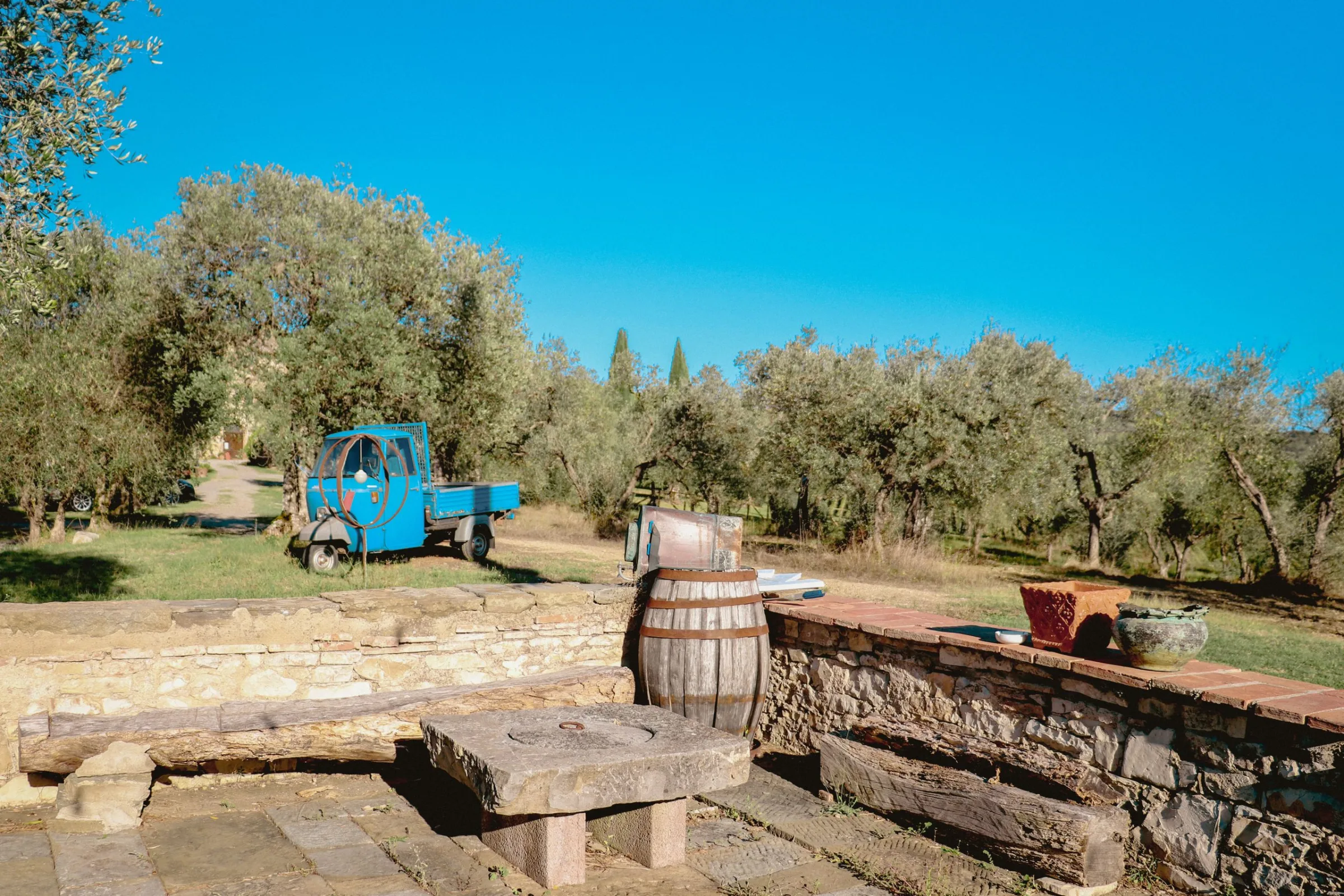
Italy's agriturismo is the most formalised version and worth understanding because it shows what regulation can do.
Under Italian law, a property can only call itself an agriturismo if agriculture remains the primary activity. There are requirements about the proportion of income from farming versus hospitality, and about food served being produced on the farm or sourced within the region. The rules vary by region and enforcement is imperfect, but the principle holds: the farm has to be a farm.
The consequence is that a genuine agriturismo has a working rhythm you can observe. There are tractors at six. There is a harvest that takes precedence over your breakfast. The wine on the table came from the field you can see.
The test of a farm stay is whether something on the property would still be happening if you cancelled. If the answer is no, it is a hotel with chickens.
Agriturismo (Italy) / Casa rural (Spain) / Gîte (France). Paid accommodation on a working farm, usually self-contained, often with dinner available. €60–140 a night. No work expected. The most comfortable entry point.
WWOOF — Worldwide Opportunities on Organic Farms. You work roughly 4–6 hours a day in exchange for food and accommodation. Membership costs €20–70 per country per year. This is not a holiday; it is a labour exchange, and the hosts who get the best out of it are clear about that from the start.
Homestays. A room in a family home, common in Vietnam, Nepal, Georgia, Peru. Cheap, immersive, and the quality varies from exceptional to grim. Community-run booking networks — Kyrgyzstan's CBT, Nepal's community homestay networks — solve much of the variance.
Farm hotels. Properties that use agricultural aesthetics as branding. Frequently very comfortable and frequently expensive. Not what this article is about, but not a bad thing either — just know which you are booking.
For most long-haul trips the flight dominates the footprint so heavily that other choices are a rounding error against it. That does not make those choices pointless — it makes their value local rather than climatic, and worth judging on what they do for the place rather than for the atmosphere.
Three things worth knowing before the first one.
It is early. Farms start at first light and the noise starts with them. If you want to sleep until nine, this is not the accommodation category for you.
Meals are at fixed times, together. On many farm stays dinner is a single sitting at a long table with the family and the other guests. This is the best part and it is also non-negotiable — arriving at nine because you lost track of time means eating alone and having caused a problem.
You will be given more food than you can eat. Refusing is difficult and pacing yourself early is the only strategy that works.
Low bar, and worth clearing:
Ask before entering working areas. Livestock buildings have biosecurity implications and a visitor walking into a lambing shed is a genuine problem, not a nuisance. Close every gate you open. Keep dogs on leads. Do not feed animals without asking — diets are managed and the wrong thing causes real harm.
Offer to help and accept the answer. Usually it is no, because you would be slower than doing it alone. Occasionally it is yes, and those are the afternoons you remember.
Buy something on the way out. The margin on a bottle of oil sold at the door is worth more to the farm than the room rate.
Tuscany and Umbria for the developed version, though the popular valleys have drifted toward the hotel end. Puglia and Basilicata for the same thing at half the price with fewer visitors. Slovenia has an excellent, well-organised network — turistična kmetija — that is chronically under-visited. Portugal's Alentejo. The Azores, for dairy. Georgia's Kakheti for wine, where the homestay-with-vineyard is essentially the default accommodation.
And in most of these, the low season — when the farm is working hardest and the guest numbers are lowest — is when the experience is most genuine and least expensive.

Contributing editor, food
Rafaela cooks, and then writes about why a dish is made the way it is. Based in Porto, she covers markets, producers and the long arguments communities have about their own recipes. She has never once recommended a restaurant she did not pay for.
Independent travel journal
Long-form travel writing with the practical parts left in — what it costs, when to go, and what the person who lives there thinks about it.