First, the thing that has changed and that most older articles get wrong: since April 2023 Nepal has required a licensed guide for trekking in several regions, and the status of independent trekking in the Khumbu has been repeatedly announced, walked back and locally interpreted.
As of the most recent season, the Khumbu — the Everest region — has been operating differently from the restricted areas, with the local rural municipality issuing its own permit and enforcement varying. Check the current position with the Nepal Tourism Board and the Khumbu Pasanglhamu Rural Municipality before you book anything. Anyone who tells you the rule confidently, including a blog post from last year, is guessing.
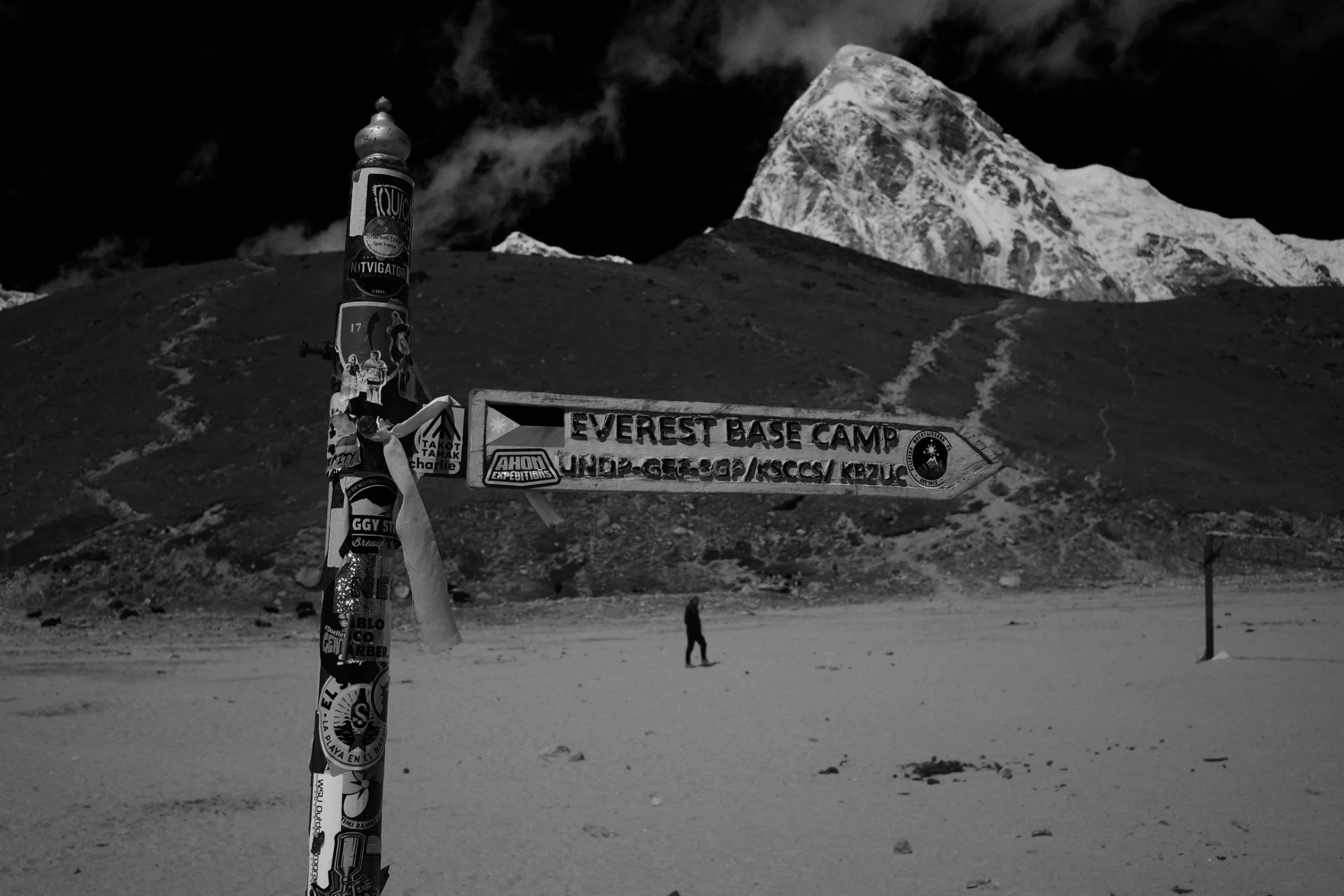
Base Camp sits at 5,364 m. Kala Patthar, the viewpoint most people actually climb for the Everest view, is 5,644 m. At that height there is roughly half the oxygen available at sea level.
The rule that prevents most problems: above 3,000 m, do not increase your sleeping altitude by more than 300–500 m per night, and take a rest day every 1,000 m. "Climb high, sleep low" is the standard practice — walk up several hundred metres in the afternoon, come back down to sleep.
The standard itinerary builds in acclimatisation days at Namche Bazaar (3,440 m) and Dingboche (4,410 m). Do not skip them because you feel fine. Feeling fine on day four has no predictive value for day eight.
This article describes activity with real risk. It is an account of our experience, not instruction. Assess your own competence, check conditions on the day, and confirm that your insurance covers what you intend to do — many policies exclude trekking above a set altitude, motorcycling and diving.
Acute mountain sickness starts as headache, nausea, poor sleep and loss of appetite — which is also what a hard walking day at altitude feels like, hence the difficulty.
The two conditions that kill are HACE and HAPE. The signs that mean descend now, tonight, without discussion:
Descent is the treatment. Not rest, not oxygen, not medication — descent. Five hundred metres down usually produces improvement within hours.
There is a Himalayan Rescue Association clinic at Pheriche with volunteer doctors who give free altitude talks daily at 3pm. Go to it.
The standard is twelve to fourteen days round trip from Lukla: Phakding, Namche, Tengboche, Dingboche, Lobuche, Gorak Shep, Base Camp, then down.
Two extensions worth the extra days:
Gokyo Lakes and Cho La pass. Adds four to five days, takes you over a 5,420 m pass, and the view from Gokyo Ri is — most people who have done both say this — better than Kala Patthar. Far fewer trekkers.
Walking in from Jiri or Salleri. Adds five to seven days at low altitude. This is how everyone did it before the Lukla airstrip. It solves acclimatisation almost entirely, costs less, and passes through villages that see almost no trekkers.
Tenzing-Hillary airport has a 527 m runway on a 12% gradient ending in a rock wall. It is safe when flown in good conditions by the pilots who fly it constantly, and it is cancelled frequently — fog, cloud, wind. Delays of two to four days happen every season.
Build slack in at the end of your trip. People who booked an international flight for the day after their scheduled return are the ones paying 500 USD for a helicopter out.
Independently, walking: teahouse bed 500–1,500 NPR (often free or nominal if you eat there), meals 600–1,200 NPR each and rising sharply with altitude, permits around 5,000 NPR, Kathmandu–Lukla flight 200–220 USD each way. Budget roughly 35–50 USD a day on the trail.
With a guide, add 30–40 USD a day; with a porter, 20–25 USD. If you hire either, verify insurance — porter insurance is a real issue and reputable agencies will show you the policy.
Pre-monsoon (March–May) and post-monsoon (late September–November). October is the clearest and the busiest. Winter is possible, very cold, and much emptier. Monsoon, June to early September, means cloud, leeches below Namche and no view.

Writer, gear & logistics
Tom tests things until they break and then reports how long that took. Packing systems, boots, cold-weather kit, missed connections and the unglamorous mechanics of getting from one place to another. Nine years on the same duffel bag and counting.
Independent travel journal
Long-form travel writing with the practical parts left in — what it costs, when to go, and what the person who lives there thinks about it.