Libraries are built by confident institutions. The confidence is nearly always misplaced — the empire falls, the order is dissolved, the regime changes the alphabet — and the books, improbably often, remain.
What follows are six collections that outlasted whatever created them, and one that is still being fought for.
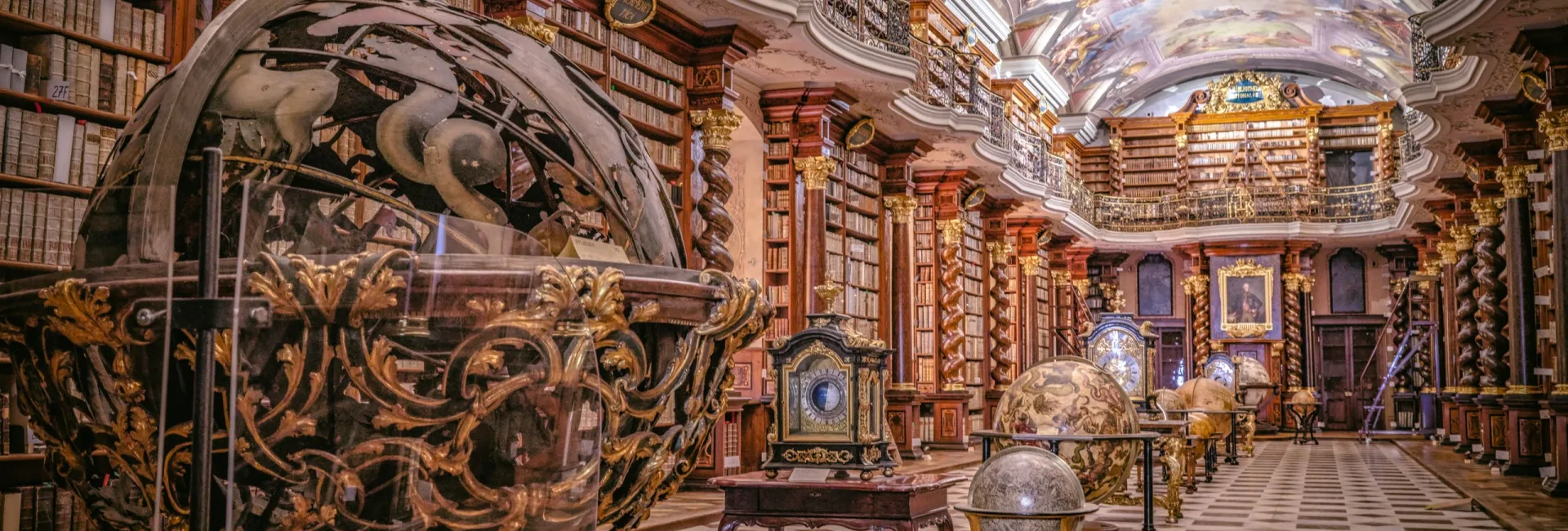
A Premonstratensian monastery founded in 1143, with two halls that have survived the Hussite wars, the Thirty Years' War, Josephine reforms that dissolved most Czech monasteries, Nazi occupation and forty years of communist rule during which the monastery was closed and the monks imprisoned.
The Theological Hall has a barrel-vaulted ceiling of stucco and fresco and a set of astronomical globes. The Philosophical Hall is twelve metres high with walnut shelving brought in from a dissolved monastery in Moravia in 1794 — the shelving is itself a refugee.
You view both from the doorway. The reason is conservation and it is non-negotiable, which disappoints visitors and is correct.
The largest monastic library room in the world — 70 metres long, seven cupolas, white and gold, finished in 1776. In 1865 a fire destroyed most of the abbey. The library survived because it was in a separate wing and because the monks formed a chain.
The design encodes a theory: the room is organised so that light falls on the books rather than on the reader, and the ceiling frescoes run from human knowledge at one end to divine revelation at the other. It is an argument about epistemology built at architectural scale.
This is the one that matters most and is least visited.
From the thirteenth century, Timbuktu was a centre of scholarship with private family libraries holding manuscripts on astronomy, medicine, law, mathematics and poetry — hundreds of thousands of documents, in Arabic and in African languages written in Arabic script, held by families across generations.
In 2012, when armed groups took the city and began destroying shrines, librarians and families moved the manuscripts out. They packed them into footlockers and rice sacks, moved them by donkey cart, canoe and car down the Niger to Bamako — an estimated 350,000 documents, over several months, in secret.
Most of the Timbuktu manuscripts survive today because several hundred people decided, individually, to break the law and move a footlocker.
They are now in Bamako, where humidity is a far greater threat than it was in the desert, and conservation is ongoing and underfunded. The digitisation effort is partial.
Everything mentioned here was paid for at the normal rate. Beyond The Geo does not accept press trips, hosted stays or comped meals — see our editorial policy for the full position.
The counter-example belongs here. On 25 August 1992, the Vijećnica — Sarajevo's city hall, housing the National and University Library — was shelled with incendiary rounds. Around two million items burned, including 155,000 rare books and manuscripts.
Citizens formed a human chain under fire to pull out what they could. A librarian, Aida Buturović, was killed doing it. The building has been rebuilt and reopened in 2014. The collection cannot be.
The Malatestiana, Cesena. Opened 1454 and the only humanist library surviving with its original building, furniture and books intact. The volumes are still chained to the desks. It is on the UNESCO Memory of the World register and it is essentially unaltered in 570 years.
The Library of Congress rotunda, Washington. Built after the British burned the original in 1814 and after a second fire in 1851; the current collection began with Jefferson's personal library, sold to Congress to rebuild.
Wiblingen, Germany. A Benedictine library in a monastery secularised in 1806 and subsequently used as barracks. The library room, with its columns painted to imitate marble, survived by being closed and forgotten.
Almost all of these restrict access, photograph rules and lighting for conservation reasons. Flash is banned everywhere and the ban is not decorative — cumulative light exposure is the principal degradation risk for pigment and paper.
Most also have a reading room or study access that visitors never ask about. At Strahov, Admont and the Malatestiana, a written request explaining a genuine research interest is often granted. It costs an email.

Senior writer, cities
Marcus grew up between Lagos and south London and has spent nine years writing about how cities actually work at street level — who lives where, what changed, and which neighbourhood the guidebook forgot. He walks every route he publishes.
Independent travel journal
Long-form travel writing with the practical parts left in — what it costs, when to go, and what the person who lives there thinks about it.