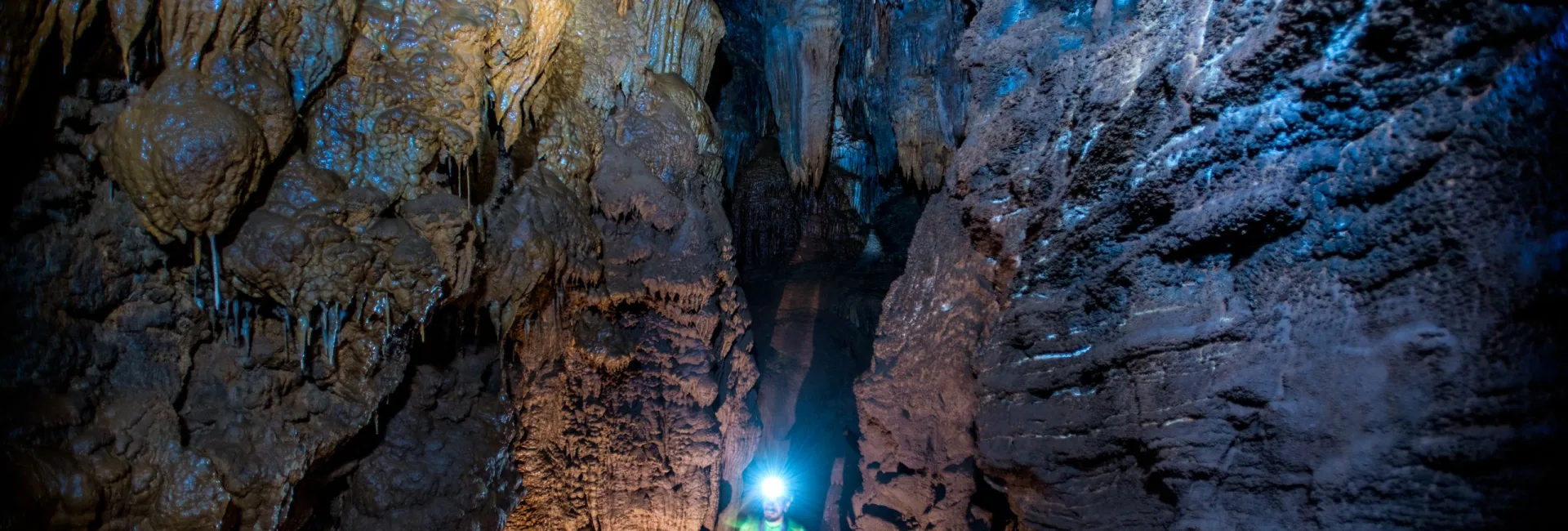
The word karst — the landscape of limestone dissolved by water into sinkholes, caves and underground rivers — comes from the Kras plateau in south-western Slovenia. This is the type locality. Every karst region on earth is named after a couple of hundred square kilometres of Slovenian scrubland.
Slovenia has over 14,000 registered caves in a country the size of Wales. Twenty-two are open as show caves. The rest require a permit, a club or a guide.
Postojna is the famous one and it is genuinely extraordinary despite — because of — being extremely commercial. You board an electric train and ride 3.7 km into the hill, which is a nineteenth-century idea that has been running since 1872. There are 24 km of surveyed passages.
The thing to actually look for is in the vivarium: Proteus anguinus, the olm. A blind, pale, aquatic salamander that lives up to a century, can go a decade without eating, and exists only in the caves of the Dinaric karst. It was described in the seventeenth century as a baby dragon and the mistake is forgivable.
Škocjan is the better cave and gets a fraction of the visitors. A UNESCO World Heritage site where the Reka river has carved one of the largest known underground canyons — the main chamber is 146 m high — and you cross it on a footbridge suspended 45 m above the water with the river audible below.
Postojna is the cave people photograph. Škocjan is the one that makes them stop talking.
Between show caves and real speleology sits a category Slovenia does well: guided adventure caving in wild caves, with equipment supplied and no prior experience required.
What this involves: a helmet with a carbide or LED lamp, an oversuit, wellingtons, a harness. Four to six hours underground. Crawling, some climbing, at least one section where you will need to be told what to do with your feet because you cannot see them.
Operators run these around Postojna, in the Rakov Škocjan valley, and near Cerknica. Expect €60–120 per person.
Three things nobody prepares you for.
The temperature is constant. Slovenian caves sit between 8 and 12°C year-round, which feels cold on entry and warm within forty minutes of moving. Overdressing is the standard beginner error.
The dark is total. Not dim — total. At some point the guide will ask everyone to switch off their lamps, and the absence of any photon at all is a sensation most people have never had. Some find it peaceful. A few find it genuinely unbearable, and there is no way to know which you are until it happens.
The silence has structure. Under the total dark there is water — dripping, running, occasionally roaring — and once your eyes have nothing to do, hearing rearranges itself around it.
Check the practical details in this article against an official source before you travel. Prices, permits and opening times were verified in the month shown at the top of the page and they move faster than we can re-publish.
If it takes, the route in is a club. The Speleological Association of Slovenia — Jamarska zveza Slovenije — coordinates around 40 clubs, several of which welcome foreign visitors and run training weekends in English. Membership brings insurance, rope training and access to permits for caves that are otherwise closed.
Slovenia also holds Vrtoglavica, a 603 m single vertical shaft — one of the deepest known — and Krubera-class exploration continues in the Kanin massif. This is genuine frontier caving and there are still passages nobody has walked.
Postojna and Škocjan are both about an hour from Ljubljana and forty minutes from Trieste, connected by bus and train. Both run year-round. Book Postojna online in summer; Škocjan runs fixed tour times and rarely sells out.
Bring a fleece regardless of the surface temperature, and shoes you do not mind ruining.

Photography editor
Yusuf shoots and edits everything visual here, and writes the pieces about how the pictures get made. He is based in Istanbul, works with a single 35mm lens more often than he admits, and has strong opinions about photographing people without asking.
Independent travel journal
Long-form travel writing with the practical parts left in — what it costs, when to go, and what the person who lives there thinks about it.